
Vanillin
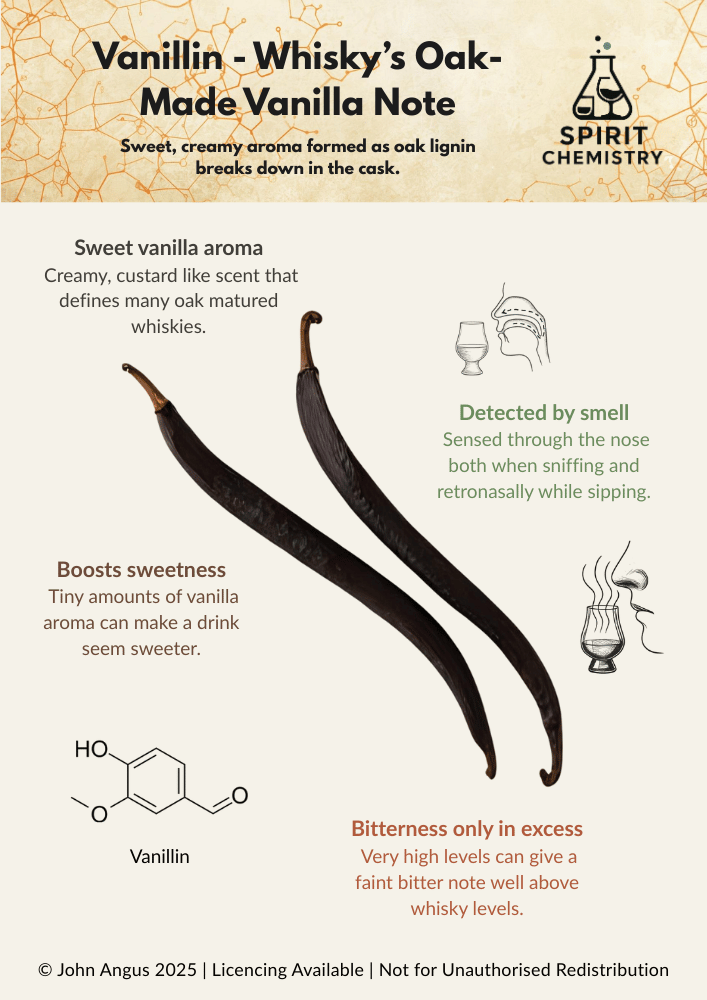
Sweet, cream aroma. Made as lignin breaks down in the cask

✨ Kicking off a new series The Distiller’s Flavour Handbook.
Each week I will break down a key flavour compound in whisky, how it forms, how we taste it and why it matters.
Most tasting notes stop at “vanilla” without asking where that flavour comes from.
Vanillin is pure oak chemistry at work.
🌿 Sweet vanilla aroma
Vanillin is the main source of the classic creamy, custard like scent found in bourbon and many long aged single malts.
It gives the soft dessert note that signals time in oak.
👃 Detected by smell
Our brains pick it up almost entirely through smell receptors.
You sense it both when you sniff the glass (orthonasal) and when aromas travel from the mouth up to the nose while sipping (retronasal).
🍯 Boosts sweetness
Even tiny traces of vanilla aroma can make a drink taste sweeter than it really is.
It is a well studied example of how aroma and taste interact.
⚠️ Bitterness only in excess
At concentrations far higher than those naturally present in whisky, vanillin can activate certain bitter receptors and add a faint bitter edge.
In normal maturation levels you will only notice the sweet aroma.
🔎 Takeaway
From the first whiff to the last sip, vanillin shapes the flavour story of every oak matured spirit.
It is the opening chapter in the Distiller’s Flavour Handbook, a series exploring more than sixty compounds that build whisky’s character.
Next time I will share an overview of how vanilla itself develops inside oak, where vanillin comes from and how it moves into the spirit.
💬 Which whiskies give you the richest vanilla notes
👇 Share your favourites in the comments
Hi-Resolution copy available to download for paid members
♻️ Pass this along to anyone curious about the science of flavour
➕ Follow for more weekly deep dives into the chemistry of spirits
